

 Explore Worlds
 Find Life
 Defend Earth

The Artemis II mission: What to expect

Watch with us
NASA's Artemis II mission is launching the first humans back to the Moon in over 50 years. A crew of four astronauts will travel on a 10-day mission around the Moon and back, kicking off the first crewed mission of the agency's Artemis program, which aims to land people on the Moon in 2028 and eventually set up a base there.
Latest Updates
When will Artemis launch?

By Asa Stahl
Science Editor
NASA has identified several potential launch dates for Artemis II, with the earliest scheduled for April 1 at 6:24 p.m. EDT. Other possible launch dates include April 2-6 and April 30. For a detailed timeline of the mission, scroll to the bottom of this page.
Artemis II is a test flight, meaning that its primary objective is to demonstrate key systems that would be needed for a crewed mission to land on the Moon. That include Artemis II's launch vehicle, the Space Launch System (SLS) rocket, and its crew capsule, Orion.
The mission is expected to take about 10 days to complete. The mission will launch from NASA’s Kennedy Space Center in Florida, using Launch Complex 39B — the same historic pad used for Apollo and Space Shuttle missions. After SLS carries Orion into space, Orion will orbit Earth twice while the crew tests out its systems. Then the mission will head for the Moon, eventually flying as close as 8,000 kilometers (5,000 miles) from its surface. After traveling back to Earth, the crew will reenter the atmosphere, descend under parachutes, and splash down in the Pacific Ocean.

The crew
Four astronauts have been selected for NASA’s Artemis II mission: Commander Reid Wiseman (NASA), pilot Victor Glover (NASA), mission specialist Christina Koch (NASA), and mission specialist Jeremy Hansen (Canadian Space Agency).
Reid Wiseman is a native of Cockeysville, Maryland. He first gained an interest in spaceflight seeing fighters jets fly overhead and, one time, the Space Shuttle on the back of its 747 transport plane. After earning his Master's degree in systems engineering from Johns Hopkins University, Wiseman became a Navy test pilot and ultimately a captain in the navy. He was selected as a NASA astronaut in 2009, flew on an expedition to the International Space Station in 2014, and served as chief of NASA's Astronaut Office from 2020-2022.
Christina Koch is a native of Grand Rapids, Michigan, and has wanted to be an astronaut since she was five years old. After earning a bachelors and a master's degree in electrical engineering from North Carolina State University, she worked as an electrical engineer at NASA Goddard Space Flight Center. There, she contributed to science instruments on multiple NASA missions. Around this time, she served as a research associate for the U.S. Antarctic Program. Later, as an engineer at the Applied Physics Laboratory, she worked on missions including NASA's Juno spacecraft, which is currently orbiting Jupiter. She was selected as a NASA astronaut in 2013. In her expedition to the ISS in 2019, she was part of the first all-female spacewalk in history, and also set the record for the longest continuous stay in space for a woman.

Victor Glover was born in Pomona, California. He earned his bachelors degree in general engineering from California Polytechnic State University, then became a test pilot for the U.S. Navy, where he was given the callsign "Ike" — short for "I know everything." While serving in the Navy, he earned three Master's degrees (in flight test engineering, systems engineering, and military operational art and science) from Air University and the Naval Postgraduate School. Glover was selected as a NASA astronaut in 2013. In his expedition to the ISS in 2020, Glover became the first African American crewmember to live long-term on the space station, as opposed to staying for a brief period as Shuttle or ISS assembly crew did.
From London, Ontario, Jeremy Hansen earned his bachelors in space science and master's degree in physics from the Royal Military College. He served as a pilot in the Canadian Air Force and was selected by the Canadian Space Agency (CSA) as an astronaut in 2009. He has also served as CAPCOM, the Capsule Communicator, between Mission Control and the ISS.
Other Artemis missions
In 2022, the Artemis I mission sent the Orion spacecraft on the same trajectory around the Moon that Artemis II will take, but without a crew. Overall, the mission was a successful test.
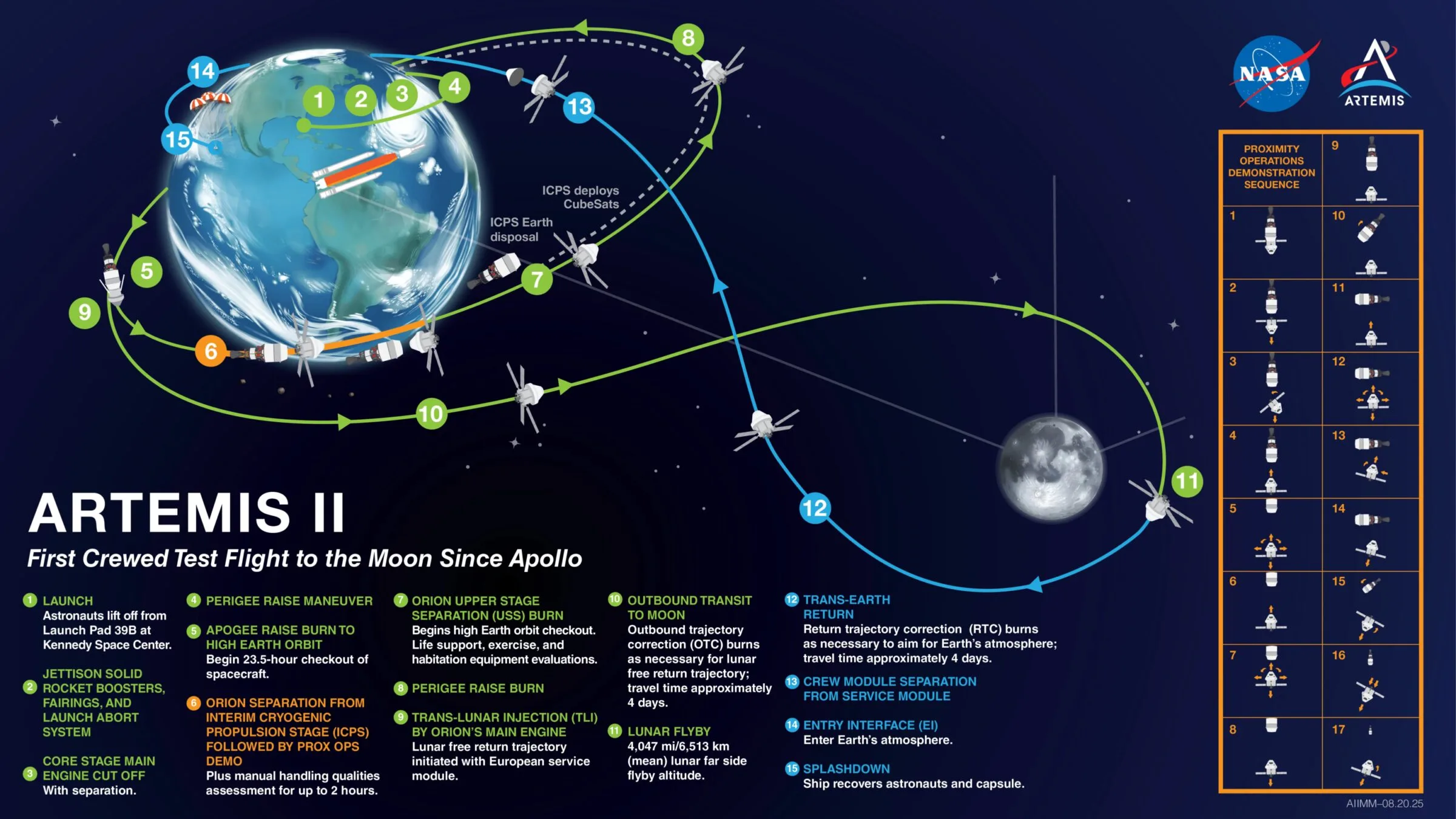
If Artemis II succeeds, the next mission will be Artemis III, a crewed test where Orion will dock with a lunar lander in low-Earth orbit. After that, Artemis IV intends to mark the first crewed Moon landing mission since the Apollo era. NASA is aiming to conduct this roughly 30-day mission to land astronauts on the lunar south pole by 2028. Artemis IV will use the SLS rocket to launch the Orion capsule into orbit around the Moon. Once there, two of the crew’s four astronauts (not yet chosen) will descend to the lunar surface on another spacecraft, possibly SpaceX’s Starship Human Landing System. Those two astronauts will spend about a week near the lunar south pole. They will explore the Moon's surface and perform science experiments before returning to lunar orbit to join the rest of their crew for the journey back to Earth.
What the Artemis II astronauts will do
During the mission, the Artemis II crew will test Orion’s various capabilities in deep space. That includes life-support and environmental systems, manual piloting and proximity operations, and communications and navigation systems.
The crew will also contribute to studies of human physiology, sleep, motion, and other biological responses to space travel. For example, the AVATAR (A Virtual Astronaut Tissue Analog Response) project will use organ-on-a-chip devices to study the effects of increased radiation and microgravity on human health. While in the vicinity of the Moon, the crew also plan to make geological observations that could help scientists refine planning for the Artemis III mission.
Why are we going back to the Moon?
Although humans have been to the Moon before, we’ve spent only about 12 days there total. In such a short time, we have accomplished just a small fraction of the science that awaits us. Although robotic missions have explored the Moon since the Apollo era, it’s still worth sending astronauts back. Humans can do science more quickly, flexibly, and intuitively than robots alone, especially when exploring complex terrain and trying to select meaningful samples. The Moon also serves as a testing ground for technologies and skills that are needed for future deep-space missions, including eventual human trips to Mars.

Mission timeline
Note: L-minus numbers includes "holds" on the countdown clock, T-minus numbers do not.
The countdown
- L-48h40m: Countdown clock begins.
- L-48h40 to ~L-34: Orion, SLS, and Interim Cryogenic Propulsion Stage are powered up, and the water tank for sound suppression at launchpad is filled. Engineers conduct final prep of the main SLS engines.
- ~L-34 to L-16: Orion batteries are charged. Crew suit regulators are checked.
- L-13: The flight vehicle's air cavities are filled with nonflammable nitrogen gas.
- L-11h35 to 9h20: Hold planned.
- L-10h20: NASA decides to load propellants or not, based on a briefing about the weather and propellant tank. Over the next hour, transfer lines are cooled to prepare for propellant loading.
- L-9h25: Over the next 4 hours, 730,000 gallons liquid hydrogen and liquid oxygen fill the core stage and the ICPS. Propellants are also replenished and topped off, and venting systems are tested.
- L-8h40: Crew wakes up.
- L-5h40: Crew dons spacesuits.
- L-4h40 to 4h: Hold planned.
- L-4h to 3h20: Crew enters Orion and performs communication checks and leak checks.
- L-3h15 to ~1h45: Closeout crew checks Orion's hatch and seals. They also install the hatch's service panels and the launch abort system hatch.
- L-1h10: Launch director is briefed on results of checking over the flight vehicle for defects.
- L-45m: Closeout crew leaves launchpad. Main crew are now the only ones left on the pad.
- L-40m to L-10m: Hold planned.
- L-16m: Final poll of launch team to be GO for launch.
- T-8m: Crew Access Arm retracts.
- T-5m: Abort system armed.
- T-2m to 1m: SLS and ICPS switch to internal power.
- T-30s: Ground launch sequencer switches over to an automated launch sequencer. This system conducts thousands of checks, on its own, every second.
- T-6.6s: Main engines ignite sequentially.
- T-3s: Main engines reach full thrust.
Flight
- T-0: Liftoff! Solid rocket boosters ignite.
- T+10s to 15s: Launch director hands control to Mission Control Center in Houston.
- T+90s: "Max Q," when pressure on the rocket is highest.
- T+2m: Boosters separate at an altitude of roughly 48 kilometers (30 miles). At this point, Artemis II is traveling at about 4,990 kilometers per hour (3,100 miles per hour).
- T+3m: Abort system jettisoned.
- T+8m: Main engine cutoff at an altitude 160 kilometers (100 miles). At this point, Artemis II is traveling at about 28,160 kilometers per hour (17,500 miles per hour).
- T+8m20s: Core stage separates.
- T+20m: Orion extends solar panels.
- T+49m: ICPS performs a perigree raise burn.
- T+1h48m: ICPS performs a second burn to establish a high elliptical orbit.
- T+3h: Orion separates from ICPS to perform a proximity operations demonstration., practicing rendezvous and docking. The crew tests manual control systems.
- T+5h: Cubesats deploy from ICPS.
- T+13h44: Perigree raise maneuver.
Rest of mission
- Day 1: Over 24 hours in Earth orbit, the astronauts perform a proximity operations demo with the ICPS and make sure various spacecraft systems are working (water, toilet, carbon dioxide removal, communications). The crew sleeps in two four-hour periods.
- Day 2: Orion engines fire for several minutes, accelerating the spacecraft to escape velocity and sending the crew toward the Moon on their free-return trajectory. The crew also works out on a flywheel and do video calls with people on the ground.
- Days 3-5: Orion performs three trajectory corrections to fine-tune its approach to the Moon. The crew tests the medical kit and performs a CPR demo. On day 5, they test their spacesuits.
- Day 6: The crew flies by the Moon, coming within 6,400-9,600 kilometers (4,000-6,000 miles) of its far side. Their maximum distance from Earth is between 370,000-450,000 kilometers (230,000-280,000 miles), depending on their launch date. This may exceed the current human record set by Apollo 13. The crew takes photographs and videos of the Moon's far side.
- Days 7-9: Orion performs three trajectory corrections to fine-tune its return to Earth. On day 7, the crew rests off-duty, and on day 8, the crew demonstrates the construction of a radiation shelter construction demo and performs manual piloting tests.
- Day 10: The crew dons spacesuits and compression garments to prepare for reentry. About 122,000 meters (400,000 feet) above Earth, Orion's service module separates from the crew module, and Orion reenters Earth's atmosphere at 40,000 kilometers per hour (25,000 miles per hour). Two drogue parachutes slow Orion to roughly 480 kilometers per hour (300 miles per hour). Then, three pilot parachutes, followed by three main parachutes, slow the capsule to 27 kilometers per hour (17 miles per hour). Artemis II splashes down off the coast of San Diego, California.
Related pages

Artemis, NASA's Moon landing program
Artemis is NASA's effort to send astronauts back to the Moon for the first time since the Apollo program.

Why send people back to the Moon?
What can an astronaut do on the Moon that a robot can’t?

Principles for Human Spaceflight
These principles lay out how The Planetary Society will evaluate, support, and critique proposed plans for human spaceflight.