

 Explore Worlds
 Find Life
 Defend Earth
Planetary Radio Episodes
Since 2002, Planetary Radio has visited with a scientist, engineer, project manager, advocate, or writer who provides a unique perspective on the quest for knowledge about our Solar System and beyond. The full show archive is available for free.

Steve Platts, chief scientist of NASA’s Human Research Program walks us through the health experiments aboard Artemis II, followed by Planetary Society Chief of Space Policy Casey Dreier on NASA's Ignition Day announcements.

As humanity heads back to the Moon, Europe is stepping up. We bring you voices from the European Space Conference and take you inside the Moonlight Initiative panel building the Moon’s future.

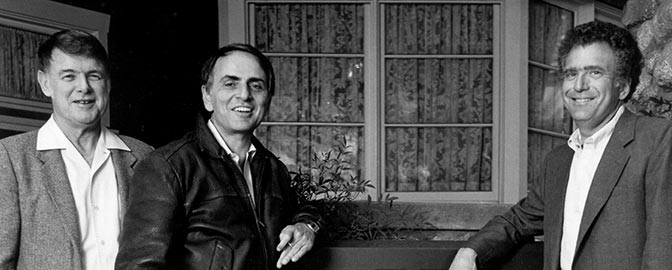
Gentry Lee, the subject of the new documentary “Starman,” reflects on nearly five decades at JPL, the missions that defined the Space Age, and the search for life beyond Earth.

NASA has restructured the Artemis program, shifting Artemis III from a planned lunar landing to a low-Earth-orbit systems test following the rollback of Artemis II. We hear remarks from NASA leadership and break down what the changes mean with Planetary Society space policy experts.

A new study explores whether a massive ancient impact briefly triggered cryovolcanism on Uranus’s moon Umbriel. Sarah Al-Ahmed speaks with Adeene Denton about how crater modeling reveals clues to the moon’s hidden interior.

A new chapter begins at The Planetary Society as Jennifer Vaughn becomes CEO and Bill Nye steps into his new role as chief ambassador.
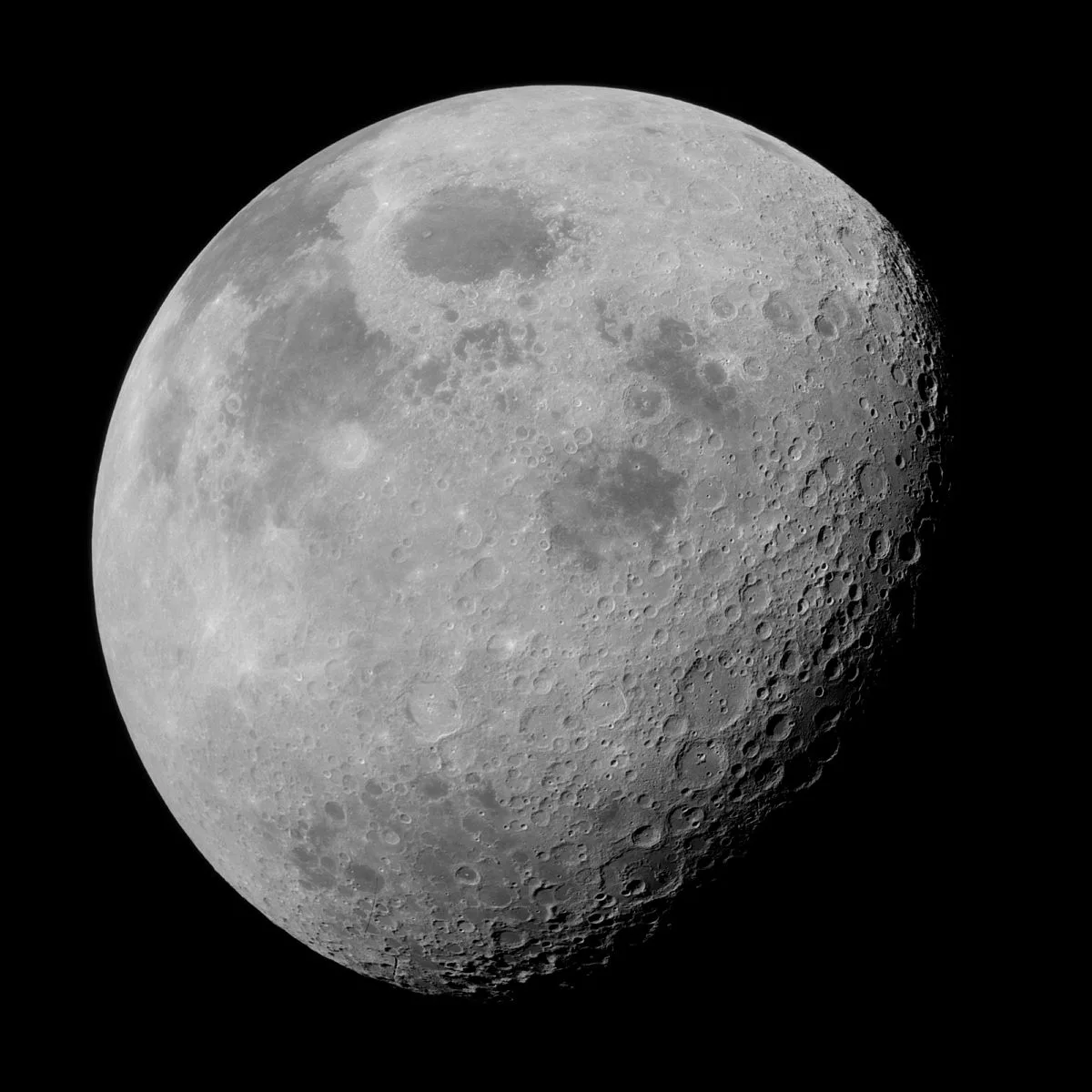
Scientists are using Apollo Moon dust to trace where Earth’s water came from and how our planet became habitable. Planetary scientist Tony Gargano explains how lunar samples reveal the history of ancient impacts, with a short bonus reflection from George Takei on Star Trek and the Artemis era.

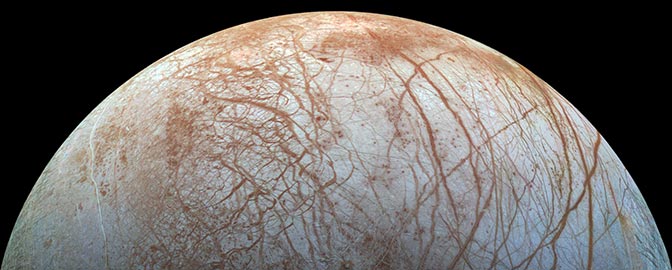
New research suggests the seafloor beneath Europa’s vast ocean may be geologically quiet today, reshaping how scientists think about habitability on one of the Solar System’s most intriguing ocean worlds. Planetary geologist Paul Byrne of Washington University in St. Louis joins Planetary Radio to discuss.

This week on Planetary Radio, Sarah Al-Ahmed is joined by Kelsey Young, Artemis Science Flight Operations Lead and lead of the Artemis II Lunar Observations and Imaging Campaign, and Noah Petro, project scientist for Artemis III. Together, they explore how geology and human observation are shaping humanity’s return to the Moon.

Congress has passed a budget that restores near-full funding for NASA science after months of uncertainty. We break down what was saved, what was lost, and what comes next.

The delightful astrophysicist and science communicator Adam Frank shares his thoughts about the search for life and intelligence across the Universe in the Planetary Society’s member book club.

Host Sarah Al-Ahmed speaks with David McComas, principal investigator of IMAP and IBEX, and Matina Gkioulidou, IMAP project scientist, about how energetic neutral atoms let us map the heliosphere.

Linda Spilker, project scientist for the Voyager mission, explains what Voyager has revealed about the heliopause and the Solar System’s outer edge.

After DOGE cuts, mass staff departures, and a blink-and-you-missed-it pivot to Mars, how much did NASA actually change in 2025? Space Policy Online founder Marcia Smith returns to assess a turbulent year.

Planetary Radio looks back at the biggest space exploration stories of 2025, from stunning images and major missions to hard lessons about how science moves forward. Host Sarah Al-Ahmed is joined by members of The Planetary Society’s communications team to reflect on what defined the year, and what they’re most excited to see in 2026.
As NASA faces unprecedented proposed cuts to its science programs, Planetary Radio looks back at a pivotal year for U.S. space policy and advocacy. The Planetary Society’s space policy team unpacks what happened, why funding uncertainty matters, and what comes next for space science.

Thirty years after NASA’s Galileo spacecraft became the first to orbit Jupiter, scientists and engineers gathered to reflect on the mission that transformed how we see the giant planet and its moons.

Why do we explore space? In this Space Policy Edition rerun, Casey Dreier speaks with philosopher Dr. J. S. Johnson-Schwartz about why space science is a moral obligation, beyond economics or prestige.

NASA’s ESCAPADE mission is on its way to Mars to study how the solar wind interacts with the planet’s magnetic fields and atmosphere. This week, we talk with Ari Koeppel and PI Rob Lillis about the mission’s launch and science goals, and examine Martian aurora in What’s Up.

Planetary Radio shares Casey Dreier’s appearance on Smart Girl Dumb Questions, where he and host Nayeema Raza explore why space exploration matters and whether NASA’s budget is worth the cost.