

 Explore Worlds
 Find Life
 Defend Earth
Planetary Radio • Mar 20, 2026
Book Club Edition: The Giant Leap: Why Space is the Next Frontier in the Evolution of Life
On This Episode

Caleb Scharf
Senior Scientist for Astrobiology, NASA Ames Research Center and Winner of the Carl Sagan Medal
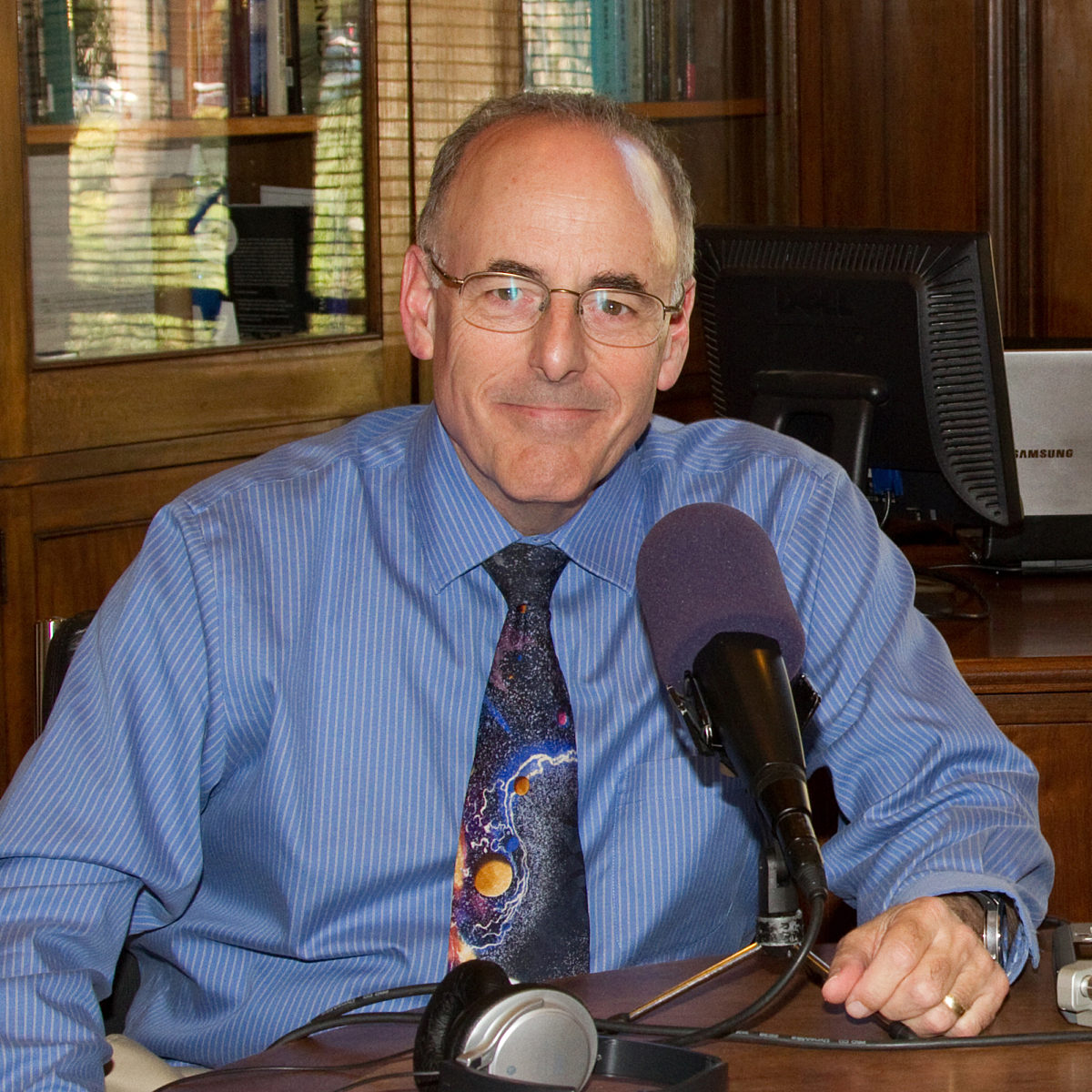
Mat Kaplan
Senior Communications Adviser and former Host of Planetary Radio for The Planetary Society
Join us for an awe-inspiring conversation with astrobiologist and astronomer Caleb Scharf as he eloquently makes the case for "dispersal," the nearly inevitable advance of life and humanity across our solar neighborhood. From the book: "The idea of Dispersal is one where the sheer scale and scope of life’s future extension into the solar system profoundly changes things: not because of some new (and unlikely) cultural enlightenment from within but because of what the enormous expanse of space will do to dilute and change our species and all others.” Adam Frank says of the book, “If we can make it through the many crises of the next century, then the Solar System and the stars beyond await us. In The Giant Leap, Caleb Scharf demonstrates how becoming a true space-faring species is more than just humanity’s future.”

The Planetary Society Book Club: The Giant Leap by Caleb Scharf Join us for an awe-inspiring conversation with astrobiologist and astronomer Caleb Scharf as he eloquently makes the case for "dispersal," the nearly inevitable advance of life and humanity across our solar neighborhood. From the book: "The idea of Dispersal is one where the sheer scale and scope of life’s future extension into the solar system profoundly changes things: not because of some new (and unlikely) cultural enlightenment from within but because of what the enormous expanse of space will do to dilute and change our species and all others.”
Transcript
Mat Kaplan: Will spreading across the solar system turn us into a new species? That's this week on Planetary Radio's Book Club Edition.
I'm Mat Kaplan of The Planetary Society, with more of the human adventure across our solar system and beyond. Change a species environment, change the availability of the resources it needs to survive, its challenges and threats, and that species will adapt as best it can. Charles Darwin saw the truth of this nearly 200 years ago, as he voyaged on HMS Beagle. And he expected humans to evolve in the face of the same pressures. Caleb Scharf believes becoming a space-faring species, one that lives on and between other worlds, will inevitably do the same to us, or our descendants. His book about this topic is The Giant Leap: Why Space Is the Next Frontier in the Evolution of Life, published just last year. By the way, this is a theme we'll return to soon in The Planetary Society Book Club, part of our rich and very active online member community. That's where I welcomed Caleb in February of 2026. Here's our great conversation.
Caleb, thank you so much for joining us today.
Caleb Scharf: Oh, my pleasure to be here.
Mat Kaplan: And a pleasure to have read your book as well, which I hope a lot of the folks who have joined us live have already done. If you have not, we're going to go through a fair amount of the basics of what Caleb covers in this galaxy encompassing book.
Let me tell you a little bit about our guests. Caleb Scharf works in the fields of exoplanetary science and astrobiology. He writes extensively about science for folks like you and me. He received the 2022 Carl Sagan medal, while serving as Director of Astrobiology at Columbia University. He's now the senior scientist for astrobiology at NASA's Ames Research Center, which has been such a center of astrobiology for so many years. I've enjoyed his contributions to one of my three favorite magazines, Scientific American. He divides his time between Silicon Valley, where Ames is, and New York City. Although today, we find him in one of my favorite locales, upstate New York, not terribly far from Woodstock.
Let me first talk about some of the praise for this book, The Giant Leap, which was published by Basic Books earlier this year. Here's what Sean Carroll, author and physicist, had to say: "The Giant Leap is a detailed and provocative exploration of what it means for life as we know it to escape the bounds of the only planet where it has ever been," as far as we know. "We have taken the first tentative steps and this book will inspire people to think more seriously about the next ones can and should be." And then from our recent guest here in the book club, Adam Frank, who I guess he's a pretty close colleague of yours, Caleb.
Caleb Scharf: Yeah, we've definitely done some research together, and we enjoy chatting whenever we get the chance.
Mat Kaplan: I've only had one conversation with him, but I envy you if you get to talk to him regularly. That was a lot of fun. Here's what Adam said. "If we can make it through the many crises of the next century, then the Solar System and the stars beyond await us. In The Giant Leap, Caleb Scharf demonstrates how becoming a true space-faring species is more than just humanity's future: it's something even greater. An essential transition for life itself." "In the engaging, beautifully written and closely argued The Giant Leap, Scharf shows us how the 3.5-billion-year evolution of life on Earth has led to this moment as the biosphere itself stands at the precipice. The Giant Leap is a must-read for anyone interested in life in the universe, space travel, and human future." I think Adam puts it very, very well.
Caleb Scharf: It sounds like a good book.
Mat Kaplan: Yeah, I couldn't agree more. Let me get into some of my many questions. I have pages and pages of highlights and questions, as usual. I'm sorry to say we probably won't get to all of these. Let's talk right at the top about this term that you apply throughout the book: dispersal. Give us the elevator version of what that term means to you.
Caleb Scharf: Well, I wanted to come up with an easy way to reference the idea that life that moves beyond its point of origin, its planetary point of origin, undergoes changes, and will undergo changes, and is entering into a different kind of landscape, different kind of dynamic. And so I felt that it needed a label, it needed a word of its own. And dispersal seemed to fit, because obviously anytime life moves beyond where it currently is into new terrain, it is in effect dispersing. But I think dispersal in the way I use it in the book has some added nuance to it, some added meaning, in terms of what that then does to life. And we have plenty of examples from the history of life on Earth about what may happen to living systems as they extend themselves, as they move into new niches, as they encounter new environmental circumstances, new environmental pressures.
And so dispersal is doing a lot of heavy lifting hit. It's conveying the notion of life spreading and extending itself, but it's also trying to give a easy label to the idea that that is a profound change in the evolution, or the evolutionary history of life. Anytime life moves further afield, it will inevitably change. And so a part of the book is talking about what those changes might look like, especially in the context of what we have seen happening in the history of life on Earth. So that's the long-winded version. That's a long elevator ride, but there it is.
Mat Kaplan: I probably could have only made it to the 15th floor or so, I would say, on that. But I think that was perfect. We learned so much from, as you've said, how we have learned life has developed on Earth. Because of that, I look forward to coming to some of the quotes that you use at the top of chapters from that great explorer of life on Earth, Charles Darwin. But here's one of the many, many passages from the book that is really striking. It's from chapter seven. "The idea of dispersal is one where the sheer scale and scope of life's future extension into the Solar System profoundly changes things, not because of some new and unlikely cultural enlightenment from within, but because of what the enormous expansive space will do to dilute and change our species and all others." That's kind of awe-inspiring.
Caleb Scharf: I'm glad you think so. Yeah, that's a great quote, because it follows up from my attempts to define dispersal. Yeah. One of the key things here in the book is that, I didn't want to write a book that was a sort of standard gung-ho exposition of how we're going to move out into space. And of course, it's our destiny to do this. I don't actually think that way. But I do think as an astrobiologist in terms of the evolution of living systems, the nature of living systems, and what the factors are that shape those living systems. And as you expressed by quoting that little passage, part of the most obvious difference between life that has been essentially confined to the surface of the Earth over the last four billion years, versus life that has managed to somehow find its way out beyond and into the Solar System, is that we're talking about very, very different physical scales, hence the idea of dilution.
There's a lot of real estate out there, and much of it is empty, and it's just going to be space between things. But on a scale unprecedented in the history of life on Earth for the last four billion years, but also in terms of potential resources, it's a very, very different and staggeringly large and rich landscape that life is just now starting to poke its nose into, that has implications, for what we may become, and what life on Earth may become, because I also discuss in the book how, yes, it's us doing this, us and our technology, we're heavily augmented by the extensions of our technology, but we inevitably take other life along with us. And we also essentially sort of send influence back to the Earth, from everything we learn, from the technology that we use to monitor the Earth, but also to learn about other worlds in the Solar System. It inevitably has effects back here on the home world.
Mat Kaplan: You speculate that we may instinctively be aware that we're kind of on a cosmic clock. I mean, you talk about how in a billion years, what is it that the Sun will be hot enough that it's going to start breaking apart water molecules into their constituent oxygen and hydrogen, and we'll lose them much as what has happened on Mars, apparently. I thought we had a lot more time, first of all, than a billion years. So that's a little worrying.
Caleb Scharf: I mean, planetary science is sometimes an inexact science, but yes, in a billion years, the Sun's luminosity will have increased to the point where water molecules will start to get into the stratosphere in number, and then be photodissociated into oxygen and hydrogen. Hydrogen will escape off into the universe, and you won't make that water molecule again. And so the planet will in effect dry out, will begin to dry out.
Mat Kaplan: Even before we're swallowed up by the Sun some millions of years into the future.
Caleb Scharf: Absolutely, yeah.
Mat Kaplan: So I mean, your point in this line from the book is, it's a fascinating thought that maybe we are in a sense programmed to look for salvation that we may instinctively be aware that we're on this cosmic clock, as you say in the book.
Caleb Scharf: I mean, it may be a little bit of a reach. I think these days it's hard to imagine that humans aren't incredibly parochial., But I do think there's something about even the experience of the night sky when it's not polluted by our own nightly illumination, the sense of depth, the sense of span, the sense of our own potential insignificance. I think people have been experiencing that for a very long time and writing about it for at least thousands of years. And I feel somewhere in there, there have to be these questions that people have asked themselves, which is, "Well, just how secure am I? How likely is it that on this planet orbiting one of these stars, things are going to turn out okay versus not turning out okay?"
And yeah, whether or not we as biological organisms have an instinct or intuition for our limited span, I think we individually can certainly have a sense of our limited individual lifespan, and maybe that's the basis of this insecurity. But some insecurity is a good thing, because it causes you to take actions, to perhaps try to improve your sense of security, at least some humans seem to want to do that.
Mat Kaplan: And maybe a pressure we have felt for a long time in [inaudible 00:13:01] limited ways. There is one more just wonderful passage. Actually, there are several more, but one that I want to read now before we move on further into the book. It's such a nice Sagan-like phrase, if you'll pardon the compliment. Here it is. "Each of these other stars is also surrounded by its own set of planetary shores in an abundance of other worlds." And then it continues a bit lower on the same page. "Life itself is an eruptive launch in the world, a pulsing fountain of self-directing matter. It swarms and grows, and it fills the niches that surround it, and the niches that it creates seemingly out of nothing. Life restructures material and diverts the flow of energy, carrying elements and opportunity into new places and new stories." Wow. It also says to me, I mean, just how we've realized fairly recently, I guess, how life itself has reshaped our own planet.
Caleb Scharf: Very much so. And as much as I was trying for something a little poetic and to raise the emotions of the reader, that description is also, as you suggest, founded in our latest sort of insights and understanding about the nature of life. And it's kind of interesting in the field of astrobiology. And actually, planetary science as well. If you go back 20 or 30 years, we tended to talk more about life occurring on a planet. It's a thing that is allowed by the planet. And that phrasing I think has evolved. And today, we talk more about how life happens to a planet. Life is a very powerful force. It's a catalytic phenomena, it's an autocatalytic phenomena, right? Life doesn't just require a habitable planet. It actually modifies the habitability of a planet, as we have seen on the Earth. The Earth is much more habitable in the sense of its capacity to sustain life than it would be if we were still waiting for life.
So yeah, this idea of life as this very vigorous, explosive fountain of matter that somehow shapes and organizes itself, and evolves, and carries information into the future, and acts on that information, and modifies its environment, not really with intent, but just because of the fundamental nature of Darwinian selection and evolution, this is what happens. To me, it is an inspiring idea that the phenomena that we're part of is this remarkably vigorous and fountain-like thing that just... It happened to a planet, it doesn't happen on a planet. I think that's an important distinction. And that is a distinction that we make at a technical level as well, when we're considering the possibility of life, not just on the Earth, but on other worlds in the Solar System and in their past, or further afield in exoplanetary systems.
Mat Kaplan: Already some fun comments. I mean, here's one from Timothy. "Human civilization, a billion years old? Wow, hard to imagine that with our current war-like tendencies and global stockpiles of weapons of mass destruction. A lot has to change."
Caleb Scharf: I very much agree with the sentiment expressed there. And I think a couple of things about ideas of the far future, assuming we make it through the next day, the next week, the next year, whatever it takes at the moment, is that whatever is here in a billion years, if it is part of our lineage, it won't be us. It'll be different, in some form. And if we continue to extend ourselves into the Solar System, in particular if we undergo this thing I call dispersal, I think we'll be even more different. In fact, we may end up being not just a single species of human descendants, will be multiple species of human descendants, because that's what happens when life spreads into new environments. So, I totally agree thinking about us worrying about a drying out planet in a billion years time may seem a little ludicrous, but I don't think it'll be us anyway worrying about that. If we're lucky enough to be part of a lineage that persists, it'll be something else that's worrying about that.
Mat Kaplan: You introduced Charles Darwin and his long voyage on the good ship Beagle right up front in the book. His work and writings are such great metaphors, or are precursors for what you document and predict about our expansion across the Solar System. I think that's fair, right?
Caleb Scharf: Yeah. When writing the book, I was looking for some kind of framework to help guide the story of space exploration, but also the deeper implications of it all. And it bubbled up for me that Darwin's Voyage on the Beagle was a terrific example at several different levels of what I think space exploration means.
On the one hand, the technical aspects of Darwin's voyage on the beagle, really remarkably similar to the technical aspects of human space flight today. You look at the preparations made for the vessel itself. It had 22 chronometers to try to keep track of the time, because that was essential for navigation. They replaced the iron cannons with brass cannons to reduce the distortions on the Earth's magnetic field, so they could use the compasses with more confidence. The crew was handpicked. It was really, it was a vessel setting out on a five-year planetary voyage. But at a much deeper level, I think the story of Darwin on the Beagle and what it exposed him to as a sort of overview effect, a sort of 19th century overview effect, propagated into his development of this profound theory of evolution that in turn evolved us.
We don't always think about it this way, but Darwin's theory of evolution, like many other big, bold, scientific theories of the world, was so influential and has been so influential. It arguably put us onto a different evolutionary track. It modified how we think about the nature of inheritance and change in ourselves, in all the species that we rely on, or the species we see around us. It also gave rise to the quest to decode the molecular structure behind inheritance, and natural selection, and evolution, in molecules like DNA and RNA. And now, of course, we have gene editing as a consequence of that. And I also think that Darwin's ideas about evolution, that we're inspired in part and largely because of that voyage around the world, those ideas have propagated into economics, into psychology, and even I think form part of the intellectual backdrop for modern machine learning, for AI, this idea of feedback induced change, the idea of selection, weeding out the best solutions to a problem. That's all part and parcel of modern machine learning and AI.
So, Darwin's story on the Beagle, apart from it just being a marvelous story, he was very articulate, and wrote marvelous diaries, many of which I use for quotes at the beginning of chapters, but that story I think is a really good parallel to what is happening with space exploration. In this case, maybe it's not one voyage, but many, many voyages that we've been going on for the last 60 to 70 years, but the impact of our access to space on us as a species on therefore all life on Earth, because if we change our actions, it inevitably modifies the environment for other species. It's a pretty clear parallel, I think, and it's a good lesson that space exploration is not just some sort of esoteric, dry thing that is the province of only the wealthiest nations on the planet. That's no longer true, very, very certainly no longer true.
And what access to space has done to us is profound, and it's only just beginning. So, Darwin's Voyage on the Beagle and that whole story was just a really attractive way to try to provide a framework throughout the book, a framework of reference, and to remind us that stories repeat themselves, and scientific stories, the structure of scientific discovery, and stories, and exploration, tend to repeat themselves as well.
Mat Kaplan: So do you think that Darwin considered how his concept of evolution would maybe someday be applied to other fields, as you point out, like economics, and now artificial intelligence?
Caleb Scharf: It's a good question. And I probably have to read more of Darwin's writings to really answer that. I mean, I think he was well aware of the profundity of what he was saying. And his theory of evolution, of variance and selection of traits spoke to the entire history of life on the planet. And of course, in that sense, it went against the grain of many of the prevailing ideas about where we came from, and where life came from, and how life changed over time. So, I think he was probably aware of its impact, certainly on our understanding of the nature of biological entities and of the history of life. And I suspect, because it had an impact in society, right? I mean, you don't get to have satirical cartoons drawn of you if you haven't impacted society. And Darwin certainly had his share of those.
Mat Kaplan: He still is. He's still getting them.
Caleb Scharf: Yes, absolutely. What a result. So I think, yeah, I don't think he could have foreseen the relationship of his theory to things like... Well, maybe he did to economics and psychology, and obviously machine intelligence was a long way off, but I'm sure he thought about what was the actual physical basis of inheritance. How was this coming about? Where was the information? Where were the sort of blueprints? Although that's a somewhat archaic way of looking at it. Where were the plans for each organism being stored? How were they getting passed on generation to generation? People had only the sort of most superficial ideas about that at that time. So, maybe he saw that down the line people were going to have to try to solve this, to understand the physical-chemical basis of inheritance of information transmission and so on.
It would be a marvelous conversation to have. I mean, I wish I could reach back and show Darwin everything that spilled out of his ideas, and I think he would be in wonderment at it.
Mat Kaplan: I wonder, maybe Charles Babbage thought that someday. There's an interesting thought based on-
Caleb Scharf: I think absolutely. Babbage definitely, and Ada Lovelace and others were seeing quite far into the future.
Mat Kaplan: Fascinating. So I had no idea until I read the Darwin quote that you used at the top of chapter four, that Darwin, Charlie, was an exobiologist. I mean, here it is. "Well, may we affirm that every part of the world is habitable, whether lakes of brine or those subterranean ones, hidden beneath volcanic mountains, warm mineral springs, the wide expanse and depths of the ocean, the upper regions of the atmosphere, and even the surface of perpetual snow, all support organic beans." And then this in chapter six: "How great would be the desire in every admirer of nature to behold if such were possible the scenery of another planet." My God, what a mind. I mean, he was predicting extremophiles as well as alien life.
Caleb Scharf: Absolutely. Isn't that just a description of modern astrobiology, the first quote? It hit every mark, including the idea of life in the atmosphere. Now, I don't know if he was thinking about bacteria necessarily, but of course, we now know that there are certain microbial species that seem to have life cycles that engage with cloud structures and the upper atmosphere. And yes, even the Arctic and the Antarctic, these seemingly barren frozen wastelands are of course replete with organisms. And then, yeah, he's speculating about, wouldn't it be interesting to see what it's like on another planet? Remarkable. And these were the things he wrote as part of his diary of the voyage of the Beagle. So he was still a young person when he wrote those, he was in his late 20s, early 30s. It wasn't the old curmudgeonly looking Darwin that we often, often see portrayed. This was a young, lively mind.
And yeah, he was boiling over with ideas and reactions to, I think, what he saw on this voyage, five years exploring vast tracts of the planet Earth, places that many people had not seen all together. Obviously, people inhabited many of these areas already, but few individuals at that time, 1830, had been to all of these places, had had that overview effect. And I think that's part of what inspired these remarkably astute observations.
Mat Kaplan: In fact, you speculate that probably Darwin had an earthbound version of the overview effect, that he experienced that, which I would think would make our friend, Frank White, a very, very happy Frank, who's also been my guest here in the Book Club and elsewhere. I think you make a pretty good case for that.
Caleb Scharf: Yeah. I think it fits. How else in the 1800s would you get to see that this continent and that continent, yes, there are some differences, but it's all essentially part of the same system. And I think that was a big piece of Darwin's revelations, was the interconnectedness of it all. He was seeing species on widely separated continents that still had similar body plans. The symmetry and their body plans were the same. They had similar strategies for survival, certain qualities and so on. I mean, if nothing else could convince you of the unity of life on Earth, then I think you're probably lacking some imagination.
Mat Kaplan: Yeah. I almost hate to do this sidelight, but it's one I want to follow. A sidelight only because it's a bit of a diversion from the main point of the book, but you do talk about how well we know our planet now, largely because of what we've been able to do from low Earth orbit. Ironic now that we're looking at the skies being clogged, and it's hurting our ability to learn about what's not on the planet. Did you see the announcement by Elon Musk that SpaceX and XAI, now the same company, want to put up up to a million satellites in low Earth orbit? Won't that be loved by astronomers?
Caleb Scharf: Yeah. It doesn't bode well for astronomy and lots of other things. Something else I talk about in the book is the fact that, especially in low Earth orbit, many satellites end up reentering the atmosphere. And that's part of the expected attrition of these devices. But there's now been a number of research studies made of chemical changes to the upper atmosphere that can be, or seem to be attributable to reentering satellites that are essentially ablating their material away. So, there are changes in the abundance of elements like aluminum, which you don't necessarily expect to see much of in the upper atmosphere of the Earth. And that modifies some of the chemistry that's taking place at high altitudes, and modifies things like particulate formation in the upper atmosphere. And the consequences of that, well, we don't really know, but they might be significant for the Earth environment.
Yeah. It's at the same time, I think, well, there's the million satellites of SpaceX and XAI, the idea there is for these to be data centers. But apart from that sort of use of near Earth space, the use of near Earth space for Earth observations, and of course for telecommunications and things like GPS and so on, but for observing our planet, that has been truly transformative, starting really early on. I mean, the first weather satellite was launched in 1960, and began sending infrared tuned TV camera video of the Earth. And that revealed really for the first time the full structure of Earth's cloud systems, the water vapor distribution in the Earth's atmosphere that our meteorologists and climatologists had not seen before. We didn't really know what things like hurricanes or cyclones looked like as a whole scene from above. And then with the rise of Earth sensing satellites, and the archetype of that is the landset series of satellites, petabytes of data of the Earth's surface, same parts of the Earth surface taken over and over again, showing changes, some of which are natural changes.
I mean, as much as human changes are not natural, but changes due to humanity, a writ large across the decades. And that information has become incredibly important. And I estimate in the book using data that's out there that it's probably injected hundreds of billions of dollars into global economies, the capacity to know what we have in our countries, or in countries next to us, or in our oceans. And to see those changes, to monitor changes to river flow, to vegetation in particular, and to actually monitor the health of vegetation, which is something that you can do using hyperspectral data from orbit. It profoundly alters our relationship to the world, and therefore alters our actions, and therefore alters the environment of the world. There's this loop, this feedback loop. It's been a remarkable thing. Whether thousands or millions of horrible little data center satellites will unduly impact that or not, I think is yet to be seen. And that's going to be an interesting debate when it really emerges into the mainstream discussion of, is this really what we want to do? Is this really how we should live our lives?
And at every level, cutting off our view of the night sky, which is so profound, and so freely available to every human who's ever existed up to this point, as well as the scientific and actually commercial implications of essentially crowding near Earth space to that extent.
Mat Kaplan: And the danger of that chain reaction.
Caleb Scharf: Right. The Tesla effect.
Mat Kaplan: Yes. Yeah, exactly. I have to say, I mean, I wouldn't change at all what Earth observation from orbit has been able to accomplish for us, probably saved millions of lives, in addition to all the other benefits, but I do kind of sigh thinking that, gee, it wasn't that long ago that someone could write the book Lost Horizon and speculate that there was a spot somewhere on Earth that no one had ever visited, or seen. And probably there's no room for a Shangri-La anymore on the side of our planet. We'll have to look elsewhere.
Much more of my fascinating conversation with Caleb Scharf is just ahead. We'll talk about how our own minds are becoming the most important tool that will help humanity adapt to life on and off other worlds.
Jack Kiraly: Hi, I'm Jack Kiraly, Director of Government Relations at The Planetary Society. Last year, NASA's science program faced the largest proposed budget cut in its history. Missions were at risk, and decades of scientific progress hung in the balance. But space advocates like you stood up for the scientific exploration of space, and won. In the United States, that advocacy reached the halls of Congress. Hundreds of people from across the United States came together for our day of action to save NASA science. They held nearly 250 meetings with congressional offices, urging lawmakers to protect NASA's science programs, and it made a difference. Congress ultimately rejected nearly all of those devastating cuts. But the movement to save NASA science isn't over. Our work continues. On April 19th and 20th, 2026, The Planetary Society will host our next annual day of action in Washington, D.C., and we invite you to join us.
Our team of space policy experts will equip you with everything you need to confidently speak up for the scientific exploration of space. We give you the training, schedule of meetings, and materials, you just need to bring your passion for space.
Research shows that in person meetings with your elected representatives are the most effective way to influence policy. If you're a U.S. resident and can join us in Washington, D.C., we'd love to have you with us. Your voice truly matters. Learn more and register today at planetary.org/dayofaction.
Mat Kaplan: Let me give you a quote, not from Darwin this time, but one of your own. "In a very real sense, the ultimate evolutionary trait for overcoming gravity's barrier was thought itself." Fascinating, especially when you then move on to where you start talking about people like Tsiolkovsky, and Robert Goddard. And I wonder, do you know that, as we speak, we are only, what is it, I've got it written down here, it's only about a month and a half, less than a month and a half till the hundredth anniversary of Goddard's launch of the first successful liquid fueled rocket. Quite a milestone, and yet I don't think it's going to be celebrated by very many people.
Caleb Scharf: Perhaps not. I mean, it should be, right? That's what an extraordinary century it's been. But Goddard had a rough time of it, even back in the day when he first wrote about potentially building a rocket to take people to the Moon. There's the famous New York Times response where they sort of belittled him. And then later, after the Apollo missions actually discreetly published an apology to the long gone Robert Goddard that, well, actually, yes, we may have ridiculed you in whenever it was in 1930s, 1940s, but you were absolutely correct. So, Godard didn't manage to get all the credit he deserved. The same with, I mean, Tsiolkovsky also, I mean, I think now people in the West recognize Tsiolkovsky's extraordinary contributions, but for a long time, it was very obscure. And of course, was because of the Soviet Union, and the barriers that presented between his academic work and the rest of the world.
Mat Kaplan: Almost seems to me like when you pair these two guys, we certainly should be paying much more tribute to both of them. Tsiolkovsky as the theory guy, and Goddard the experimentalist.
Caleb Scharf: Yeah. And Goddard was experimenting with ion thrusters in 1915. He was tinkering with that in the lab. Obviously, he didn't have beautiful vacuum chambers, or the fabrication technology we have now, but he certainly understood the potential of something like that. I mean, that's more than a hundred years ago, he was working on that.
Mat Kaplan: I got to say that, yeah, the New York Times, in its wisdom, or lack of same, they said that everybody knows that a rocket can't possibly work in space because there's no air to push against. Isaac Newton was spinning in his grave. But the funny thing is, I think probably when I was seven or eight years old, I asked my father, "How does a rocket work in space?" He gave me the same explanation. So sorry, dad.
Caleb Scharf: Yeah. Yeah. But it's not immediately obvious, and it's outside of most of our day-to-day experiences. I mean, even if we light a firework, I'm not sure we really pause to think about how that's working.
Mat Kaplan: Yeah. So, let's move on to the Moon, our nearest worldly neighbor, which you talk about quite a bit. We just learned in the last couple of days, because of that damn liquid hydrogen, the natural state of liquid hydrogen is leaking. They've now pushed the launch of Artemis 2 at least into March. So fingers crossed, but here's another one of my favorite lines from the book. "The Moon may be separated from us by an ever-growing gap of space, as it moves outward, but it is in all meaningful ways Earth's last and least explored wilderness, even though every human who has ever lived has known of its existence." How striking that we have mapped its surface even before we could go there, but we didn't see the far side until just the last few years.
Caleb Scharf: Yeah, that's right. And part of why I describe the Moon that way is, of course, comes from a current understanding of the origin of the Moon, and the sort of prevailing model being that the Moon is a consequence of a protoplanetary collision between an early version of the Earth and another object, sometimes it's called Theia, that was sort of in a co-orbiting, in horseshoe orbit around the Sun with the Earth. And eventually, collided with the Earth. And the Earth as we know it today is somewhat of a mixture of what the proto Earth was, and that protoplanet that collided with it. And the Moon is also part of the sort of strict version of that earlier proto Earth and other protoplanetary object, and which is one of the explanations for why the elemental composition of the Earth and Moon are so, so very similar in so many ways. But also, with subtle differences.
So, it really is as if you peeled off a piece of the Earth at some point, like a dough off the top of a ball of dough and just reformed it a little way away. And I think the Moon deserves to be seen as a really intimate part of us, a high wilderness. It's not that easily accessible, but we're at a point where obviously we have been there and continue to send robotic probes, and maybe humans will be there again fairly soon.
Mat Kaplan: I will just drop in a few of the comments that are coming up here from other folks. John says, "So many potentially similar conditions may exist off planet. Wondrous," he says. Jeremiah says, "My fiance is in college currently and studying Darwin and all the stuff that has come from him. Really cool to hear here. Will absolutely be sharing it with her." Yeah, get her to watch the recording with you, Jeremiah. Timothy says, "HVACs, air conditioning systems, seem to be altering human evolution," he says. "Researchers suggest that human evolution has changed gears with cultural adaptations, including technologies like heating and air conditioning moving much faster than genetic evolution." Makes me think of that Marshall McLuhan quote, "First, we shape our tools, and then our tools shape us."
Caleb Scharf: Yeah, absolutely. And I can very much see that. I mean, heating and cooling, right? Such fundamental things. And of course, knowing what the actual consequences are for the evolution of our species is a really difficult problem. And it's difficult for any organism to actually map subtle behavioral environmental changes to the consequences for later versions of a species, because there are so many subtle effects. There are epigenetic effects that take place very quickly. And then actual, what we would call evolutionary changes, sort of selective changes to DNA, many, many things going on there. It's a multilayered problem. But yeah, absolutely. I think even within cells, the expression of genes changes the environment into which the next set of express genes have to engage with. And so it's almost this sort of Russian doll situation, this recursive situation.
Yeah, it's almost certainly the case that we're pushing changes into our species that are hard to see happening on a short timescale. I mean, something can happen pretty quickly in evolution, but some things can take a lot longer, and they're also complex because of the interaction of so many different environmental variables.
Mat Kaplan: Did meeting Buzz Aldrin change your thinking about humanity's role in the Solar System?
Caleb Scharf: I mean, it did in a way. And I described this a little bit in the book. I was fortunate enough a number of years ago to sit with Buzz for about an hour and just chat about things. And I was pretty all struck, pretty starstruck, I have to say.
Mat Kaplan: As I am.
Caleb Scharf: Just because, apart from his personality, which is strong and lively, it's also just the thought of this human specimen has been on another world, but it made me think about just how profound an impact that experience could have on an individual. And obviously, I don't know Buzz's inner thoughts, but at least I felt I could sense this sort of ongoing wonder in him, ongoing urge to, if not experience it again for himself, to make sure that others would eventually experience that, being on another world altogether, and what that must do to your perspective, even if you're a sort of hard-nosed, test pilot, trained astronaut, it clearly affected all of those people very profoundly. And for me, that says that there's something here that I think as a species, unless we become completely adult with AI and social media, anyone with a little bit of imagination is still going to feel that sort of primordial urge, that primordial need to know what that might feel like.
And I think that's going to remain as a driver of exploration. And thinking for myself, I don't anticipate on ever being in space myself, but through my scientific research, my sort of vicariously live through robotic explorers. And that's pretty good as well. That can give you the chills, that can definitely give you some of that feeling.
Mat Kaplan: Speaking of robotic explorers, in November of this year, Voyager 1 will reach one light-day distance from Earth. That seems to me an accomplishment we're celebrating as well.
Caleb Scharf: Absolutely. That should be a global celebration, right? I mean, that's a species reaching out to the universe. And yep, it's only a light-day, but for what we know, there may not be many species in the entire observable universe that accomplish even that. So, yes.
Mat Kaplan: Yeah. Let's turn briefly to the red planet, to Mars. I talked recently with a researcher who is convinced that the Viking Mars landers found evidence of life on the surface, but that the data has been misinterpreted. So, you make what I think is a transcendent point, that whether biological life exists there, or once existed there, we know for sure that the planet is now inhabited by, if you'll pardon the expression, silicon-based life. I'm only half kidding talking about our robots, our emissaries that have gone there, like the ones that have excited you.
Caleb Scharf: Yeah. No, I mean, the Viking results, that's a whole other discussion, and it remains interesting. And of course, the Viking missions and the experiments they carried were fantastically innovative, and bold, and worth doing. Whatever one's interpretation of those results, it set future exploration on, for the most part, very productive pathways. But yes, there is this interesting observation to make that, and I think some of it comes down to my personal feeling about the nature of human technology, and the augmentations that we build for ourselves. I see those very much as what might be called an extended phenotype, to use the phrasing from evolutionary biology, that we're perhaps a little too quick to see machines and robots as just these things that are out there, they're distinct from us. They're not really distinct from us. They are extensions of us.
And in that regard, yes, whether or not Mars has been inhabited by biological life before, or is still at some level inhabited by biological life, we do know for sure that, right now, I think right now there are nine active missions at Mars, some on the surface, some in orbit. That's a machine world. What else can it be? It's a machine world. And yes, those machines still rely for the most part on us, but not entirely. And even just this last week, we've seen work done with the Perseverance Rover using AI to plot roots for the Rover. Now, the AI wasn't directly controlling the Rover, but it did generate the command sequences and so on, which could then be thoroughly checked by humans.
It feels like a natural direction for a lot of space exploration, robotic space exploration is greater and greater autonomy. And there are many people working on that, at NASA and elsewhere. And yeah, then much like the current debate between, do we have really thinking machines in our AI at the moment? Have we crossed the barrier? Are we past the Turing test? I think there may come a point where it's almost a semantic point whether or not there's machine life out in the solar system when I think there already clearly is.
Mat Kaplan: I know some Rover drivers, Mars Rover drivers. I hope that this has not given them a new reason to worry about their jobs. They have enough reason to worry about their jobs.
Caleb Scharf: I think they're still going to be very, very important.
Mat Kaplan: I trust that. Do you think human life will be sustainable on Mars with all of the challenges that that planet presents?
Caleb Scharf: So, I think it's going to be tough. And the way I approached this in the book was to try to think about a number of different philosophical stances. I mean, you might call them ideologies, but it's softer to call them philosophical stances about how we should be engaging with Mars. In some of those stances, including ones where we imagine placing many, many humans on Mars, ideas like those that Musk has talked about of making these large human settlements, I think, well, we know it's going to be really, really hard to sustain humans on Mars. It's certainly going to be hard to sustain them in a self-sufficient way. At least it's going to take quite a lot of time to get to that point, I think.
And there are aspects to do obviously with just resources, you need water, you need food, you need air to breathe, you need oxygen to breathe, you need to cleanse CO2 out of your air supply and so on. Those are things we can probably get pretty close to self-sustaining. You have to overcome the challenges of a harsher radiation environment, challenges of actually the chemistry that surrounds you. Unless you remain hermetically sealed, you're going to encounter marsh and regolith, and some of that is kind of nasty stuff. It's full of perchlorate, and oxidizers, and so on.
So, I think it's quite a way off before we can self-sustain. And then on top of that is, and this is something that always intrigues me, and I'm not sure I've ever seen a full discussion of it, it's relevant for things like the space station as well, which is on Earth we are embedded in microbial and viral entities, right? We're just a wash with these things. And we know that they are incredibly important part of our function, our health, our immune system, our response to things, our body chemistry and so on. And the human microbiome exchanges with its surroundings. And so I worry about settling on Mars without probably need to take along, a nice arable farm from Iowa or something, scoop it up, transport it to Mars, and drop it down, and people get to roll in the soil every so often just to replenish their microbiome.
I think there are things like that which we've not fully addressed yet. So, it's going to be challenging. I suspect we can keep people alive on Mars for long enough to come back home again if it's a short stay. But beyond that, it's going to be interesting.
Mat Kaplan: To say nothing of what, if we bring that Earth biome along with us to keep ourselves alive, what it might do to any existing Martian life, I know people, I bet you do too, who are not just dreaming about terraforming Mars, but are actually laying what they see as the groundwork for accomplishing this, largely through modification of Earthly life forms, so that they can eke out in existence on that terribly hostile world. But my God, it would be such a shame, wouldn't it? To wipe out anything that might still be there.
Caleb Scharf: Yeah. And planetary protection obviously plays a big role in astrobiology and in planetary exploration, and it's super important. I do find myself moving back and forth on this, a certain amount of ambivalence, because yes, on the one hand, we absolutely want to be able to probe a world like Mars to understand whether it has had life in the past, whether it still has indigenous organisms. And dumping a lot of terrestrial organisms in that environment is not going to be a great thing to do. Even if it doesn't damage any extent life that is currently on Mars, it will greatly complicate our ability to detect that life, and to characterize that life, because everything we do will be contaminated by Earth organisms. But at the same time, to do some of this science, it does feel like we're going to eventually have to bite the bullet and get people onto Mars, in a way that they're healthy, so they're going to be carrying all sorts of stuff with them, microbial life and other things.
And the question is, how to do that in a thoughtful way that obviously minimizes the chances for overly contaminating Mars, either damaging indigenous systems, or obscuring the very things that we're trying to measure? I suspect there are ways to do it. And some of those, I think, will come from developing a much more thorough model of Mars, gathering far more data. I mean, we've gathered a lot of data on Mars, but there's much, much more to gather. And the more data we can gather using robotic instruments, it will make human exploration easier, but it will also help us put in place the sort of protections that we need to put in place if we're going to make the most out of Mars. If we're really selfish about it, right? We want to exploit Mars scientifically. We also probably want to exploit it in other ways. But there are probably ways to do this that kind of satisfy all of those needs.
Mat Kaplan: One hopes. Let's move one step further out in the Solar System to the asteroid belt. I mean, I loved that you mentioned the expanse, both the book series and the TV series. I don't know if you're a fan or not, but...
Caleb Scharf: Absolutely.
Mat Kaplan: You are? Yeah, so am I. This dream of mining the untold riches of the asteroid belt. And your calculation that the asteroid belt could theoretically be used to create an absolutely amazing 80,000 or so technospheres that are basically of the mass that we've built on Earth. And then you mentioned this other calculation by your colleague, Michael Maltner, that maybe there's enough there for 6,000 biospheres of the nature and mass of what has been created on Earth. Those are pretty stunning numbers, and a strong-
Caleb Scharf: They are, right?
Mat Kaplan: Yeah.
Caleb Scharf: Yeah, they are. And 6,000 or so biospheres would support something like 50-trillion humans, right? If you have approximately the same ratio of humans to biosphere that you have on the Earth. Yeah, I mean, obviously those numbers sound utterly fantastical and out there. And part of what I am interested in, and both as a scientist, but also in the book, is the idea of establishing the boundary conditions. What are the limits of life dispersing into the Solar System from the Earth? What are the constraints? And obviously, material resources are a big piece of that. Outrageous as those numbers are, they're really useful, because they tell you something about what it's like for life to extend itself into a planetary system. That is, it encounters a landscape and an environment that is vastly different than anything on a single planet. The scale of things is just so far beyond anything that life has engaged with so far.
The Earth is big, right? A lot of continental land area and a lot of ocean volume, but it's nothing compared to what's out there. Asteroids are an obvious resource because they are in some ways easier to get to. Earth has a lot of resources, but most of them are buried, and buried under kilometers of rock. Asteroids, it's not such a challenge. And especially if you are building a true space economy, and a space infrastructure. I always laugh about the asteroids like Psyche that may have a quadrillion dollars worth of platinum or other railroads. It's like, yeah, well, the thing is, if you brought that much platinum back to the Earth, the value of platinum would plummet. It would be worthless. It only really makes sense on the scale of a Solar System economy. And that is where you do start to see the path to your 80,000 technospheres, or your 6,000 biospheres, and your 50-trillion humans, or whatever comes after humans, occupying all of the habitats that you build out of that.
I mean, it's mind-blowing, but it is a constraint on the problem. I hesitate, and certainly in the book I hesitate to make direct predictions about what's going to happen, because that's a fool's game. I think it's Niels Bohr who said something to the effect of, "The one thing you can't ever do is predict the future." I think that's true, but you can set the boundary conditions., And that's a known tactic certainly in physics and in the rest of science as well. I really have no idea what the answer is, but at least I can put a box around it. And that's what those numbers are about.
Mat Kaplan: There is so much more to this book. It will come back to the dispersal, since that is so key, the underlying message theme of the book. Do you think that it is inevitable, or at least likely?
Caleb Scharf: Yeah, it's a good question. And it's part of what I try to answer in the book. And my conclusion is that it may very well be inevitable. I think when you're up close to something new like space exploration, and it is still comparatively new, it can sort of be hard to see the wood for the treats, right? And it's so enmeshed with our current sort of global politics and it has been enmeshed with geopolitical strategy and tensions in the past, and to some extent it continues to be that way. And with the rise of commercial space in the way that it's happening right now, that can create controversy and we can often fall back on feeling like, should we really be paying attention to any of this? Should we be doing this at all, given all the problems here on Earth? And I think those are all valid concerns, but I think you need to step back a bit.
And the really broad picture to me says, there's probably no going back on this. Once a species does figure out how to break free of its planetary origins, there may be fits and starts, then it may be a bit bumpy. But just like the rest of biological evolution on our planet, it tends to persist. It tends to hang in there until the next leap, the next thing happens, the next sort of piece of growth. And I think we're seeing some of that now. We had this explosion of space exploration in the early 1960s through to the mid 1970s, and then everything has been on a sort of somewhat steady simmer. I mean, that's probably a little unfair. There's been a lot of remarkable stuff, especially in scientific exploration taking place.
And now we're seeing this crazy growth in the launch capacity of the world. There's now something like 30 potential launch sites around the world. We're getting very, very close to the point where there will be a rocket launch once a day throughout an entire year. We've seen thousands of objects being put certainly into near Earth space and so on. It feels like some things are foot.
So yeah, part of my take on this is, love it or hate it, I think it's kind of happening. And with so many human qualities, this is sort of what happens. You can have those of us who try to think about things and will pontificate on what should be done and what shouldn't be done. And then there's others just doing whatever. And it all sort of comes out in the wash. And I feel that's kind of where we're at. So maybe in 10,000 years, our descendants look back and go, "Yeah, it was obvious that this was going to happen." As I sip a cocktail on Enceladus, or go skydiving on Venus.
Mat Kaplan: There's a relevant comment here that just got posted by John. He says, "The genie is out of the bottle." I would tend to agree. Timothy says, "I saw a guy raise potatoes on Mars that maybe the Irish helped out with that," he says. And a lot of concern about where we are. There is a quote in the book that I think is very relevant to this portion of the conversation, and here it is. "Dispersing is far more likely to generate vast diversity and change than it is to maintain a monoculture of organisms and ideas. That is, to me..." you, Caleb, "... an extraordinarily hopeful thing. Visions of a more appealing future for life on Earth where we live sustainably and in relative harmony feel like a very, very hard reach these days." But I still hope for the Federation someday.
Caleb Scharf: Yeah. And I'm an optimist. I think if you're a scientist, you have to have a degree of optimism. And as I was thinking about the material in the book, yeah, it did occur to me, it did sort of crystallize in my mind that a very optimistic big picture view of this is that one of the solutions to our Earthly problems, maybe to dilute us. It's like when you've got a bunch of small children fighting, what do you do? You send them each to a different corner in the room, for a while at least. And there is something to be said for dilution. And with dilution tends to come speciation and diversification.
And a great example I refer to in the book is the Galapagos Islands. Those islands are geologically relatively young, species have populated those islands, species whose origins were further afield on continental landmasses. And then those species were diluted across those islands, and speciated. They underwent change, and sometimes quite rapid change. The famous finches, the Galapagos finches, the finches that Darwin studied, is a good example of that. They actually show very rapid evolution in some instances, almost season to season. The whole population shifts in its traits, and beak size, and habits and so on. And that's, I think, a good example of... To me, that's an optimistic thing for us, because again and again, we come to the problem that we're on a finite world, and we're humans, right? So, we occupy a distribution of qualities, of emotional states, of intellect, of behaviors, and that's always going to be the same. And so maybe diluting us a bit might just help break some of the impulse that we find ourselves at.
Mat Kaplan: We can certainly hope. I can't let this discussion end without mentioning one of the technologies you recognize as being able to take advantage of what you call the interplanetary transport network, which I hope you've copyrighted that term, at least for-
Caleb Scharf: Someone else has.
Mat Kaplan: Oh, well, at least this using transfer orbits, the stuff that Buzz Aldrin, I asked Buzz Aldrin once, "Which do you want to be remembered for more if it has to be one or the other? Being the second person to step on the Moon, or developing these transfer orbits?" And you said, "Oh, absolutely, the Aldrin orbits." So, forgetting cargo around. But one of the ways that you talk about a technology that could accomplish this, near and dear to our hearts at The Planetary Society, solar sailing, since we were a pioneer in that with our light sail too. And you talk about some of the other examples of how this has happened. Do you foresee a day, perhaps, with dispersal well underway, when we have cargo ships making their slow way across the solar system? And it won't be like Amazon or FedEx, but the stuff will get there eventually.
Caleb Scharf: Yeah, I think it makes a great deal of sense. And the interesting thing about putting stuff out on slow trajectories, slow transfers using weak instability boundary transfers and Lagrange points and so on is, yes, it takes a long time. It doesn't take much energy at all, which is great. And so for solar sails, it's an option. Or if you're just sort of using a solar sale for very long elliptical transfer, the interesting thing is, in space, I would envision almost a convoy of cargo on Earth. On Earth, we've gotten used to this sort of on demand stuff. So, things are on the truck for a very short amount of time, and then they show up.
But what if you had a stream of trucks going past the front of your house every day, and each truck had various essential supplies, and you just need to reach out and pluck them off the truck that happens to be passing by you at that moment? And I think in the Solar System, maybe something akin to that would make sense. Almost these little long chains of supplies that are on these perpetual low energy orbits, or low energy transfer trajectories that take them here, take them there, and you put enough stuff into those long chains that any given moment, you don't actually have to wait that long for something to show up. But you're not sort of calling Amazon and saying, "Can you deliver?" You're calling Amazon and saying, "When is the next passage of my spare batteries?" And they'll say, "Well, actually, it's in two days time. Cargo container X56 will be scooting past you. But if you wait another two days, another one will be behind it, and that's got this on it." So yeah, I think there's some interesting sort of economic transport models that could use some investigation.
Mat Kaplan: Fascinating to speculate about, John calls them slow clippers. Slow clipper ships, I suppose.
Caleb Scharf: Yeah, perfect.
Mat Kaplan: You save a shocker, Caleb, for the last paragraph in the book. Here's that quote. "Evolution almost guarantees that humans, as we are now, are likely not the ultimate beneficiaries of cosmic dispersal. Nonetheless, we might be the first to marvel at the new forms and relationships that life launches into as it becomes interplanetary." So homoasteris or something. I mean, what are you referring to there? Something beyond us.
Caleb Scharf: Yeah. And again, it's the big picture, right? The broad perspective that a species dispersing away from its planetary origin will change. It'll dilute, it'll undergo speciation. It will become new species, inevitably, I think, on the longer timescale. And it may be that that longer timescale is the real timescale for this sort of dispersal to fully establish itself, which means that, yeah, what we are today is going to be different down the line. And I mean, that would probably be true anyway, but I think something like dispersal into a planetary system undoubtedly accelerates that process. It just has to. And in ways that are going to be hard to predict, I think it's fair to consider that our salvation lies in other species that have descended from us, not us, per se.
Mat Kaplan: You can file this under... But wait, there's more, because I highly recommend if you are reading the book or if you've read it and skip Caleb's notes section at the rear of the book, it is fascinating, it is full. I highlighted a bunch of stuff in the notes section, Caleb, just because I think it's going to be useful in the future as I research things. And I have to thank you for one particular entry, directing readers to The Planetary Society's list of every mission to Mars ever, which indeed exists at planetary.org. It's not hard to find. So, thank you for that.
Another thing that you note in the notes section is your link to the trailer for a 1962 Soviet film, Planet Bur, or Planet of Storms. That link no longer works, but I found one that does, and I put it in our member community, the Book Club discussion. People can check this out. Great can't be fun. Even the two and a half minute trailer is a lot of fun. So, thank you for that as well.
Caleb Scharf: Yeah. Oh, you're welcome. Yeah, Soviet science fiction was pretty amazing.
Mat Kaplan: And this one, as you point out, has everything. It's got robots, it's got monsters, it's got a volatile surface of Venus, not as volatile as it turned out to be, after we learned the reality, beyond 1962. But anyway, absolutely fascinating. And really proof that this book throughout is really a marvelous exploration of where we are, and where we may be someday, whether it's 10,000 years, or 10 years, or tomorrow. Caleb, thank you so much.
Caleb Scharf: Well, thank you. I really appreciate it, and really enjoyed this conversation.
Mat Kaplan: Caleb Scharf talking with me not long ago in The Planetary Society's member community about his book, The Giant Leap: Why Space Is the Next Frontier in the Evolution of Life, published by Basic Books and available everywhere. Sarah will return with the weekly show this coming Wednesday. Did you know that you can wear your love for Planetary Radio? Check out our t-shirt at planetary.org/shop, along with lots of other cool and spacey merchandise. And please, help others discover the PB&J, the passion, beauty, and joy of space science and exploration by leaving a review and a rating on platforms like Apple Podcasts and Spotify. Who knows how many other curious minds you'll be helping to find their place in space through Planetary Radio? You can also send us your space thoughts, questions, and poetry at our email, [email protected]. Or if you're a Planetary Society member, leave a comment in the Planetary Radio space in our online member community.
Planetary Radio is produced by The Planetary Society in Pasadena, California, and is made possible by our steadily evolving members. Become one of us at planetary.org/join. Sarah Al-Ahmed is the host and producer of the show; Mark Hilverda and Rae Paoletta are our associate producers. Casey Dreier is the host of our monthly space policy edition. Andrew Lucas is our audio editor. Josh Doyle composed our theme, which is arranged and performed by Pieter Schlosser. I'm Mat Kaplan. Ad astra.